
StreetOps CLMS
Central Lighting Management System
Fewer truck rolls. More lights fixed.
StreetOps CLMS complements the lighting management systems you already run.
It turns a flood of alarm and telemetry information into insight and action that raises first time fix rate, reduces truck rolls, and cuts light downtime. It unifies every vendor's assets into one system, ranks alarms by impact, verifies the issue, and creates work your crews can act on. That work carries through a mobile field service app to a verified fix and a result you can report.
See an example of how a fault becomes a verified fix.
The problem
Connected lighting does not fix itself.
Truck rolls can actually increase if Networked Lighting Controllers flag outages that cannot be addressed. Using the CMS to prioritize truck rolls will be critical to ensuring O&M savings.
US Utility Smart Street Lighting Report, 2026
Cities and utilities did the right thing. They invested in connected lighting to deliver the right level of light where and when it is needed, and to improve maintenance operations and reduce downtime. What the investment did not come with was anything to effectively decide which of the faults it now reports is worth a truck.
The platform
Modular by design.
Each module closes a real operational gap on its own — and together they run the whole loop, from prioritized alert to verified fix. Below, the problem each one answers. Key capabilities, module by module, are on the datasheet.
Multi-Vendor Asset Management
LMS faults and telemetry arrive faster than anyone can sift them, so the wrong things get fixed first.
StreetOps normalizes asset, fault and event data from the LMS system you already run, then ranks what matters by impact. A whole circuit going down arrives as one incident, not fifteen. You set the rules and the judgment stays yours — process intelligence, not raw data. And we sell no nodes, so it works the same way whichever system or systems you run.
Work Order Management
Lighting system data is not an integral part of the maintenance process the team actually runs.
StreetOps creates the work automatically where the evidence supports it, and you stay in command of the rules and the outcome. The system's morning board runs the huddle your department already holds: what is on for today, who is doing it and what needs to change. We do not replace the process you run today — you get a work order capability that fits it.
CLMS Diagnostics
A truck rolls to a light that may not be broken.
Before a work order is issued and a truck rolls, StreetOps asks the light itself. It requests a reading, nudges the control, reads again, checks the switch log and returns a verdict — so the crew is sent to something that is actually broken. The same check is available to run in the technician's hand when they arrive.
Field Service Operations
Crews are not carrying laptops, and they work where coverage is spotty.
A native app for iOS and Android that works offline. Crews keep working past the edge of reliable coverage, review diagnostic history, capture root cause and photos at the pole, and everything syncs when they are back. Live readings and control at the pole give the technician what they need to finish quickly on the first visit.
Reporting & Dashboards
Detection rarely turns into a verified fix, so the performance improvement never shows up in a report.
A dashboard for what needs you now, a street map you can read at a glance, and reports you can take to a budget meeting. Because every fix was verified before it closed, the numbers describe what happened rather than what someone typed.
Service Level Agreements
Targets exist on paper, and nobody sees them until one is missed.
Set response and fix targets by priority. StreetOps watches them as the day runs and escalates anything slipping, before anyone has to ask for a status update. Compliance reporting exports when you need it.
Executing at the desk and the pole
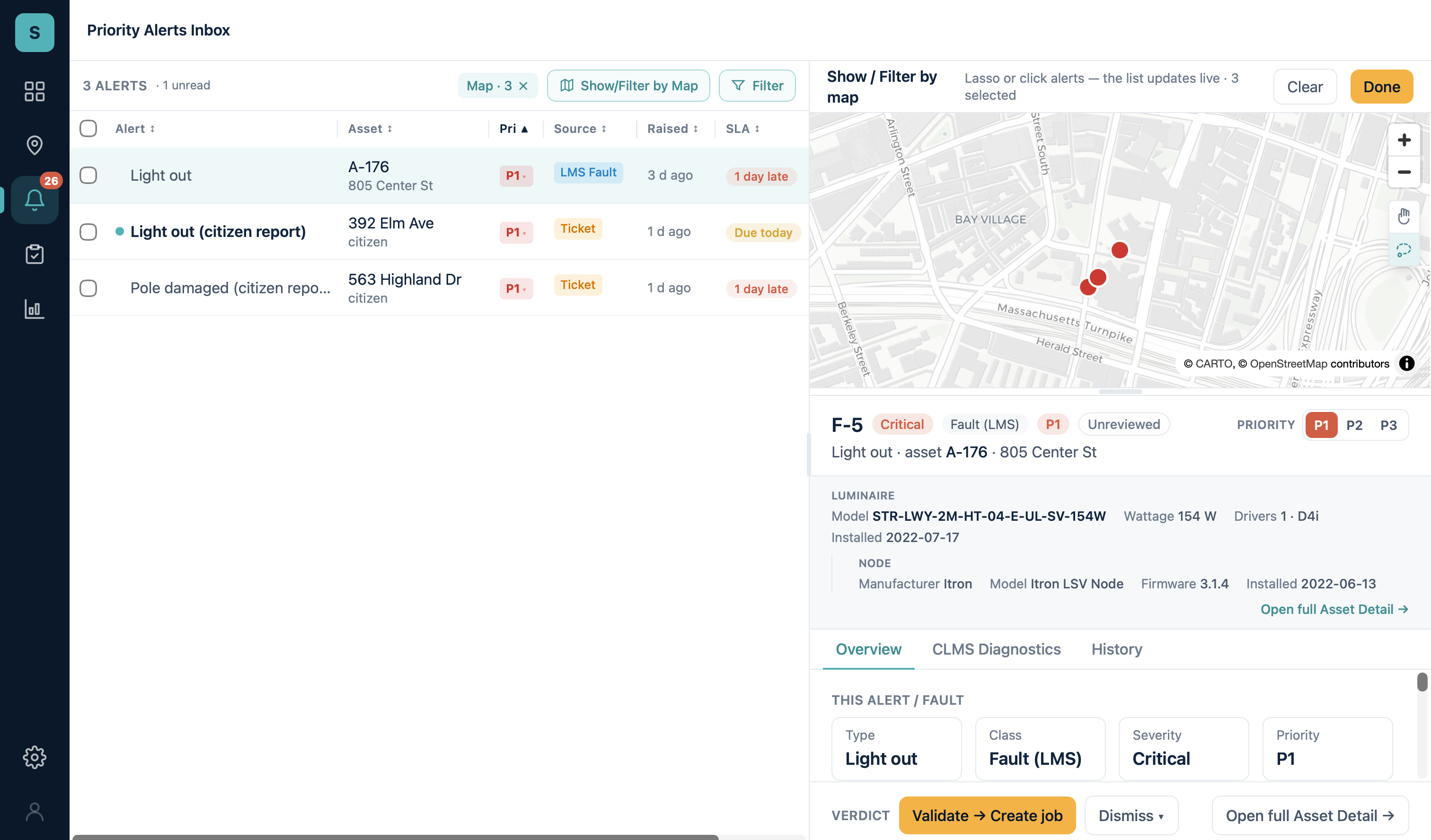
What reaches the operator is a short, prioritized list.
What the rules decided is worth a truck roll, with diagnostics run against it and a job one click away.
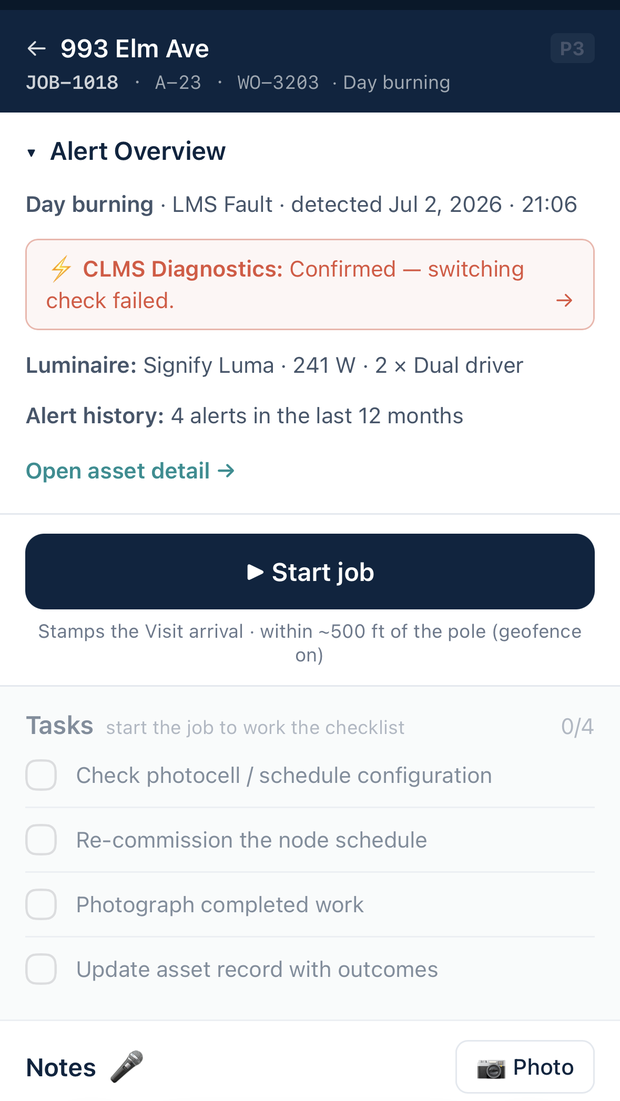
The job on the phone.
Verdict, checklist, photo, at the pole — and it keeps working with no signal.
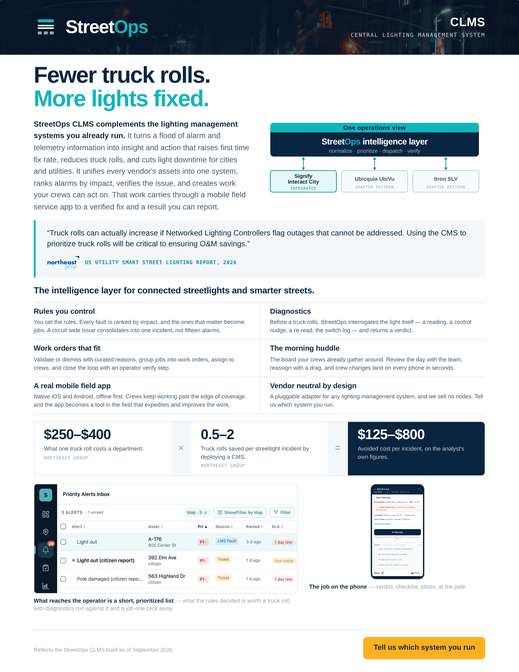
StreetOps CLMS Datasheet
Two pages. Every module and what it does today, the layer diagram, the security position in full, and the arithmetic behind the truck roll saving.
Cost savings per streetlight incident
What one truck roll costs a department
0.5–2Truck rolls saved per streetlight incident by deploying a CMS
$125–$800Avoided cost per incident, on the analyst's own figures
×=Northeast Group · US Utility Smart Street Lighting Report, 2026
Security
Secure by design.
Built to meet current and future compliance needs.
- Role based access control
- Full audit trail — every edit, assignment and closure
- Designed against IEC 62443-3-3
- On premise, your cloud or our secure hosting data center DigitalOcean
Hosted on DigitalOcean, whose platform carries SOC 2 and SOC 3 Type II, CSA STAR Level 1 and ISO/IEC 27001. Every action in StreetOps is audited, and roles carry segregation of duties.
Beyond lighting. The same layer is built and designed to flexibly extend across sensors, signage, traffic, EV and the wider streetscape. The adapter boundary that makes CLMS vendor neutral is the same one that reaches the rest of the street.
Tell us about your streetscape and what you're trying to solve →
See the platform on your streets.
The StreetOps Intro Demo walks you through the modules that matter most to your operation, and shows you how it raises first time fix rate and reduces truck rolls.